
アプリケーションギャラリには電気, 構造, 音響, 流体, 熱および化学分野に関連する COMSOL Multiphysics® チュートリアルおよびデモアプリファイルが用意されています. これらの例はチュートリアルモデルまたはデモアプリファイルとそれに付随する手順をダウンロードすることにより独自のシミュレーション作業の開始点として使用できます.
クイック検索機能を使用して専門分野に関連するチュートリアルやアプリを検索します. MPHファイルをダウンロードするには, ログインするか, 有効な COMSOL ライセンスに関連付けられている COMSOL Access アカウントを作成します. ここで取り上げた例の多くは COMSOL Multiphysics® ソフトウェアに組み込まれ ファイルメニューから利用できるアプリケーションライブラリからもアクセスできることに注意してください.

This model demonstrates how to use the built-in shape optimization functionality to improve the performance of a plate heat exchanger. The optimization reduces the path immediately in front of the inlets and outlets to increase the length of typical streamlines. This leads to a improved ... 詳細を見る

This model illustrates the modeling of temperature distribution in a simplified mixer. 詳細を見る
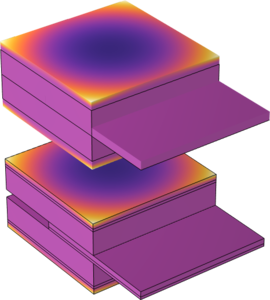
This tutorial model demonstrates the use of the multiphysics coupling feature Thermal Connection, Layered Shell, Surfaces. In this model, three layered shells are connected to heat domains by interior and exterior boundaries. The results obtained with the Heat Transfer in Shells ... 詳細を見る

This tutorial model illustrates the use of the nucleate boiling heat flux features to compute the transient cooling of a cylindrical rod plated with nickel, and immersed in a pool of boiling water. The temperature and heat flux results obtained with a 3D time-dependent computation, with ... 詳細を見る

This model simulates the flow through a uniform inclined screen using the Screen feature in Single-Phase Flow physics and compares the results with an analytic solution. 詳細を見る

This model is a benchmark model for the Slip Flow interface. It is based on both analytic and numeric calculations. Air at atmospheric pressure flows through a conducting micro-channel connecting two reservoirs maintained at different temperatures. A flow between the two reservoirs ... 詳細を見る

This tutorial illustrates the use of the connecting features in the Heat Transfer in Solids and Heat Transfer in Shells interfaces, to couple them to a Lumped Thermal System interface. The results obtained with the solid and shell models are compared. 詳細を見る

This model demonstrates how to set up a fully coupled poroviscoelastic model of biological tissues. The model is benchmarked by simulating a cyclic uniaxial tension–compression test on human brain tissue. 詳細を見る


