
アプリケーションギャラリには電気, 構造, 音響, 流体, 熱および化学分野に関連する COMSOL Multiphysics® チュートリアルおよびデモアプリファイルが用意されています. これらの例はチュートリアルモデルまたはデモアプリファイルとそれに付随する手順をダウンロードすることにより独自のシミュレーション作業の開始点として使用できます.
クイック検索機能を使用して専門分野に関連するチュートリアルやアプリを検索します. MPHファイルをダウンロードするには, ログインするか, 有効な COMSOL ライセンスに関連付けられている COMSOL Access アカウントを作成します. ここで取り上げた例の多くは COMSOL Multiphysics® ソフトウェアに組み込まれ ファイルメニューから利用できるアプリケーションライブラリからもアクセスできることに注意してください.

Extending the High Voltage Insulator model, this example shows how to set up an Optimization Study to determine the optimum position of the grading rings to obtain the highest flashover voltage. 詳細を見る
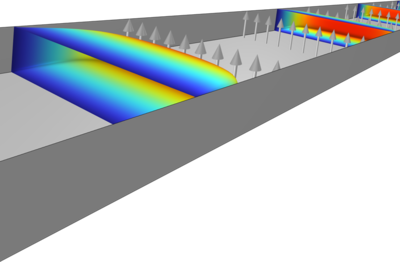
In nuclear fusion reactors, the conducting fluid, such as the fusion plasma and the liquid metal in the reactor blanket, will interact with the background magnetic field. This phenomenon is referred to as magnetohydrodynamics (MHD). The electromagnetic field and fluid flow are fully ... 詳細を見る
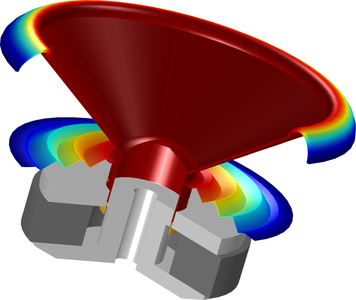
この例では, 低周波と中周波で一般的なダイナミックコーンタイプのスピーカードライバーをモデル化する方法を示します. 解析は周波数領域で実行されるため, ドライバーの線形動作が表されます. モデル解析には, 周波数の関数として, 総電気インピーダンスと公称駆動電圧での軸上の音圧レベルが含まれます. ドライバーの空間特性は, 指向性プロットで表されます. チュートリアルモデルは, 磁場インターフェースと音響構造相互作用マルチフィジックスインターフェースの組み合わせを使用して設定されます. 最初の解析では, ... 詳細を見る

Quantum dots are nano- or microscale devices created by confining free electrons in a 3D semiconducting matrix. Those tiny islands or droplets of confined “free electrons” (those with no potential energy) present many interesting electronic properties. They are of potential importance ... 詳細を見る

Lithium iron phosphate (LFP) is a common positive electrode material in lithium-ion batteries. Specific for the LFP electrode material is that its equilibrium (open circuit) potential, when defined as a function of the lithiation state, features a large flat plateau with a more or less ... 詳細を見る

Electron transport in low-temperature plasmas depends strongly on the electron energy distribution function (EEDF), which is often approximated as Maxwellian but is frequently nonequilibrium in reality. Incorporating nonequilibrium EEDF behavior into spatially dependent models often ... 詳細を見る


This is a model of a MEMS microphone solved in the frequency domain including the DC prestress effects. The model is set up using the Electromechanics multiphysics interface, Thermoviscous Acoustics, and Pressure Acoustics. The microphone consists of a perforated plate and a prestressed ... 詳細を見る
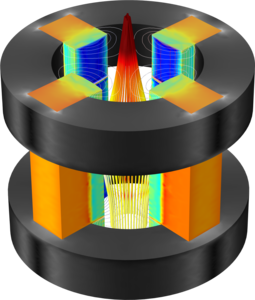
Just like optical lenses focus light, electric and magnetic lenses can focus beams of charged particles. Systems of magnetic quadrupole lenses find a common use in focusing both ion and particle beams in accelerators at nuclear and particle physics centers. This model shows the path of ... 詳細を見る


