
A Comprehensive 3-D Electromagnetic Model of Package Sealing Inductors by means of Surface Current Density
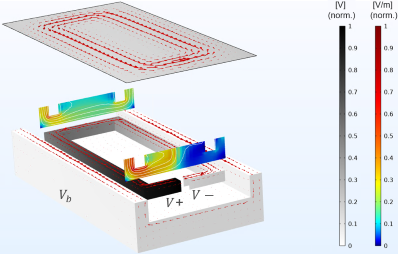
A 3-D modeling approach for the consistent computation of electric and magnetic fields in inductors employed in package sealing applications is presented. The inductor consists of a coil, a metallic body, and one or more dielectric materials. The time-varying magnetic field generated by the coil induces eddy currents in a thin aluminum workpiece embedded in a multilayer packaging material, resulting in Joule heating that enables sealing through polymer welding. Among the dielectric materials employed in the inductor to insulate the coil from the body, magnetodielectric materials are of particular interest, as they are used to guide and concentrate the magnetic flux in the workpiece sealing region while minimizing eddy current losses in the magnetic core. Comprehensive analysis of the device requires the simultaneous evaluation of electric and magnetic fields, workpiece eddy currents, magnetic and dielectric losses in magnetodielectrics, and, therefore, of the overall power dissipation. Along with these requirements, the capability to directly prescribe conductors voltage boundary conditions is needed to reproduce, in the model, the inductor bias scheme. To this purpose, a computational framework based on the A-V formulation is implemented in COMSOL Multiphysics® using the Magnetic and Electric Fields (mef) interface of the AC/DC module, where the electric scalar potential and the magnetic vector potential are solved simultaneously. By including the electric potential as a dependent variable, voltage can be prescribed on both the coil terminals and the metallic body, allowing the representation of the operating bias scheme, including the high-voltage configurations used in dielectric breakdown tests. Furthermore, the “full-Maxwell” formulation enables a consistent evaluation of electric and magnetic fields together with all relevant electromagnetic loss mechanisms, allowing the total electromagnetic power dissipated in the inductor-workpiece system to be determined. A key aspect of the modeling approach concerns the representation of the aluminum workpiece. Its relatively wide and thin geometry would naturally suggest the use of a Transition Boundary Condition (TBC). However, TBC leads to numerically challenging systems, with convergence ranging from extremely slow to unattainable depending on the solver formulation. On the other hand, in the induction sealing systems at hand, the workpiece thickness is much smaller than the skin depth, such that the thin-sheet limit of TBC reduces to a Surface Current Density (SCD) condition. Notably, SCD predicts the correct electromagnetic behavior of the workpiece while exhibiting robust and faster convergence across all tested solver formulations. The methodology is demonstrated on a simplified inductor model retaining the key physical features of induction sealing devices. Finally, the computational requirements associated with the analysis of an industrial inductor are reported.
ダウンロード
- 17401_final.pdf - 0.57MB


