
Lorenzo Bortot, CERN, Switzerland
Engineers and physicists at CERN go to great lengths to ensure that the high-power superconducting magnets that maintain the circular trajectory of particles inside the Large Hadron Collider (LHC) do not revert to a resistive state, an event known as a quench. To understand and prevent quench events, Lorenzo Bortot, an electrical engineer and research fellow at CERN, used numerical simulation to develop a multiphysics, multiscale, and multirate representation of the electrodynamics and thermal evolution of a quench event.
Suggested Stories
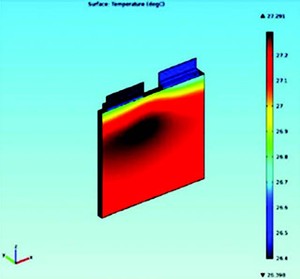
The Thermal Management of Li-ion Battery Packs
At the Fiat Research Center in Italy, Michele Gosso and Antonio Fiumara are working on the development of providing ...
砂に蓄えた太陽エネルギーで建物を暖める
Polar Night Energy は, 熱モデリングを使用して, 42トンの砂を動力源とする蓄熱および配電システムの設計を最適化しました. このプロジェクトは, ...
Seeking Out Electrical Arcing Regions in Satellite Systems
Space is the epitome of an unpredictable and harsh environment. These conditions are near impossible to replicate via ...
HPC-Enabled Simulation Aids in the Design of Customized High-Power Electrical Devices
Engineers at Block Transformatoren-Elektronik design custom coiled products, including transformers, power supplies, ...


