
W. Lee, K. Jensen
MIT, MA, USA
The chemical reactions used to generate solvents and certain pharmaceuticals rely on organic synthesis, a process of combining individual chemicals that can be accelerated through microwave heating. A microreactor system facilitates the direct, localized, and efficient temperature change necessary for successful synthesis. However, a uniform temperature distribution is crucial to the chemical process, and these reactions can be inhibited by unwanted temperature changes or heating that occurs too slowly. Wen-Hsuan Lee, a researcher at the Massachusetts Institute of Technology (MIT), fabricated a borosilicate glass microreactor to conduct this microwave organic synthesis, but when she tested her design in a microwave system, she discovered that the heating was uneven and below the desired temperature. Using COMSOL Multiphysics, she modeled the microreactor to investigate the effects of its geometry and orientation on the heating process. From her simulation results, she was able to redesign the microreactor and optimize its location and orientation in the microwave system to achieve successful organic synthesis.
Suggested Stories
数値シミュレーションでデンドライトを制御する
効率的に機能するリチウムイオン電池を設計するために Murata Manufacturing Co., Ltd. のエンジニアは電池内のリチウム金属電極に電流を加えたときに発生する樹状突起の形成を評価し, ...
Increasing Productivity and Revenue with Computational Applications
HeatSinkSim is a simulation app created by the specialists at AltaSim Technologies that can help optimize heat sink ...
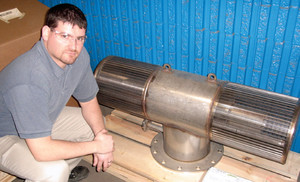
The Science of Water Screening
Johnson Screens® are the manufacturers of steel screens that impede debris from lakes and rivers from entering pipes ...
シミュレーションによる電離計の性能向上
半導体製造と素粒子物理学の研究は, 高真空または超高真空 (HV/UHV) 条件に依存します. HV/UHV 環境で圧力を測定するためのより優れたイオン化ゲージの開発を支援するために, リヒテンシュタインの INFICON ...


