
W. Lee, K. Jensen
MIT, MA, USA
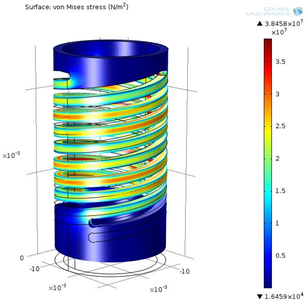
The chemical reactions used to generate solvents and certain pharmaceuticals rely on organic synthesis, a process of combining individual chemicals that can be accelerated through microwave heating. A microreactor system facilitates the direct, localized, and efficient temperature change necessary for successful synthesis. However, a uniform temperature distribution is crucial to the chemical process, and these reactions can be inhibited by unwanted temperature changes or heating that occurs too slowly. Wen-Hsuan Lee, a researcher at the Massachusetts Institute of Technology (MIT), fabricated a borosilicate glass microreactor to conduct this microwave organic synthesis, but when she tested her design in a microwave system, she discovered that the heating was uneven and below the desired temperature. Using COMSOL Multiphysics, she modeled the microreactor to investigate the effects of its geometry and orientation on the heating process. From her simulation results, she was able to redesign the microreactor and optimize its location and orientation in the microwave system to achieve successful organic synthesis.
Suggested Stories

Modeling Optimizes a Piezoelectric Energy Harvester Used in Car Tires
Siemens is a technology company working with electronics and electrical engineering in industry, energy, and ...

Analysis and Simulation of Rock Properties
VSG provides high-performance 3D visualization toolkits and software for a number of industries, including materials ...
ダリエス水車で発電し魚を守る
Physixfactor社は, シミュレーションを利用して, オランダの沿岸部の洪水対策に使用する水車タービンの設計をシミュレーションで行いました. 従来の水力発電用タービンと比較して, 新しいタービン設計では魚の死亡率が20%から1 ...
Meeting High-Speed Communications Energy Demands Through Simulation
The information and communication technology industry needs new energy-efficient devices that can keep up with the ...


