
K. Suthar, C. Benmore
Argonne, IL, USA
As part of an industry that saves lives on a regular basis, pharmaceutical companies are in need of systems that can be used to deliver high-quality medicines. One method utilizes sound waves generated by an acoustic levitator with foam-coated transducers. Using the acoustic force from the sound waves, chemical particles are suspended between the transducers, where they can be mixed in a contaminant-free space.
Using COMSOL Multiphysics, Kamlesh Suthar and Chris Benmore of Argonne National Laboratory have simulated an acoustic levitator in order to find the best geometry for controlling how liquid droplets form between the transducers. They also investigated the changes in viscosity and surface tension and the effects that such parameters have on the droplet shapes. Studying the fluid-structure interaction (FSI), Suthar explored the sound pressure levels, material properties, and geometry options for the levitator. Simulating the acoustic levitator helped them to hone their design and achieve a new degree of control over the interactions between droplets, which will ultimately contribute to life-saving advancements for pharmaceuticals.
Suggested Stories
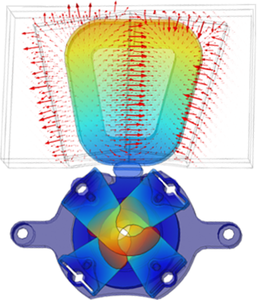
Keeping Cool: SRON Develops Thermal Calibration System for Deep-Space Telescope
Deep-space telescopes require ultrasensitive detectors and calibration to pick up weak far-infrared signals. The SpicA ...
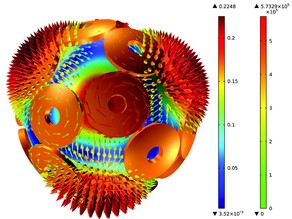
Reduced-Weight Reaction Sphere Makes Way for Extra Satellite Payload
CSEM is a private applied research and development center specializing in micro-technology, system engineering, micro ...
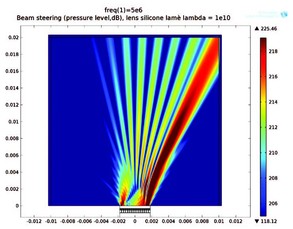
Optimizing Ultrasound Piezo-disk Transducers
Esaote S.p.A. produces medical diagnostic systems, including the manufacturing and sales of ultrasound imaging ...
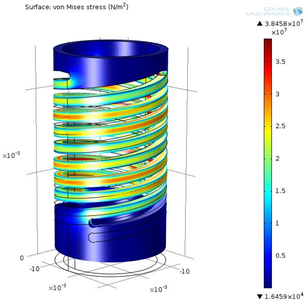
Meeting High-Speed Communications Energy Demands Through Simulation
The information and communication technology industry needs new energy-efficient devices that can keep up with the ...


