
M. Bachmann, V. Avilov, A. Gumenyuk, and M. Rethmeier
BAM Federal Institute For Materials Research and Testing
Germany
High-power laser beam welding uses a localized heat source to achieve narrow deep welds and high welding rates. Engineers run into some difficulties because the use of a localized heat source often results in the distortion of metal components; spattering and the ejection of droplets from the weld pool results in underfills, undercuts, craters, blowholes, or blowouts.
A stationary magnetic field is applied to the laser welding process to improve its quality and counteract effects such as spattering. BAM Federal Institute For Materials Research and Testing in Germany are working to improve the quality of high-power laser beam welding using COMSOL Multiphysics. To model and simulate the laser beam welding, heat transfer, fluid dynamics, and electromagnetics were coupled and solved. This allowed BAM to accurately model the process by including Marangoni effects, gravity, latent heats of fusion, and Lorentz forces.
Suggested Stories
Virtual Material Design in 3D Printing Makes Headway with Multiscale Modeling
The advantages of anisotropic properties in 3D printing materials have been difficult to exploit for product design, ...
Analyzing the LHC Magnet Quenches
Engineers and physicists at CERN go to great lengths to ensure that the high-power superconducting magnets that ...
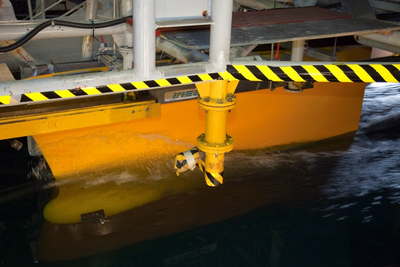
Sonar Dome Vibration Analysis
There has been a recent move towards utilizing bulbous bows on ships to house different types of sonar systems, but it ...
Keynote: Using COMSOL Multiphysics® for Circuit Board Thermal Analysis
The aerospace and defense industry requires stronger circuit boards than those needed for everyday electronics due to ...


