
Implementing, Verifying, and Optimizing Metamaterial Designs with Simulation
David Smith & Yaroslav Urzhumov
Duke University
Pratt School of Engineering
Durham, NC
Jeff Wilson
NASA Glen Research Center, Cleveland, OH
Fabio Alves and Gamani
Karunasiri
Naval Postgraduate School
Monterey, CA
Metamaterials are manufactured, structured materials that they can interact and manipulate wave phenomena such that objects surrounded by metamaterials are shielded from these waves. In the case of light, metamaterials make these objects ‘invisible’. Researchers throughout the world are applying these materials to many different applications.
At NASA Glen Research Center, physicists are currently working on potential applications for metamaterials, including a “superlens” that would provide much higher resolution than what is possible using natural materials, by utilizing the negative refraction of metamaterials.
Researchers at the Naval Postgraduate School in California are working with metamaterials in a metafilm for terahertz (THz) imaging technologies. Electromagnetic waves in the THz scale are commonly used in airport scanners as they can penetrate non-metallic materials without damaging tissue or DNA. Yet, they require expensive and complex imaging arrangements to combat the fact that most THz waves are absorbed in the air prior to reaching the target. The metafilm must be designed using the appropriate materials and geometry to attain near 100% transmission at the desired frequency.
At the Center for Metamaterials and Integrated Plasmonics (CMIP) at Duke University, led by David R. Smith, researchers are working with Toyota to use metamaterials for a wireless transfer of power in an electrical vehicle. They have accomplished this task by making the distance between the power source and the device disappear with a metamaterial-based lens.
All of these researchers used COMSOL Multiphsyics to implement, verify and optimize the designs. Further, they are using COMSOL to conceptually investigate new uses for metamaterials.
Suggested Stories
鉄道輸送の新時代に向けた架空設備装置の改善
インド政府が国の鉄道システムを活性化する計画の一環として, Raychem RPGは構造モデリングと最適化を使用して, オーバーヘッド装置 (OHE) で使用されるカテナリー線と接触線用モジュラーカンチレバーを設計しました.
The Science of Water Screening
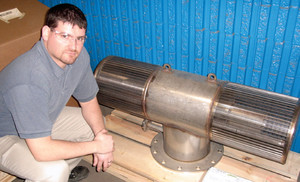
Johnson Screens® are the manufacturers of steel screens that impede debris from lakes and rivers from entering pipes ...
マルチフィジックスシミュレーションによる計器用変圧器とセンサーの最適化
電源グリッドはシステム障害から保護するために適切に保守する必要があります. ABBのエンジニアはマルチフィジックスシミュレーションを使用して過電圧に耐え水中地下貯蔵庫応用で使用できる機器変圧器とセンサーを設計します.
海底ケーブルの数値モデル化による洋上風力発電所への電力供給
Hellenic Cables 社は, 有限要素モデリングを使用して, 洋上風力発電所で使用される地中海底ケーブルの設計を解析, 検証し, 持続可能な電力で世界をより良くつなぐことに貢献しています.


