
The Colorado School of Mines Uses Simulation to Track Fluid Movement
A. Haas, H. Mahardika, M. Karaoulis, and A. Revil
Colorado School of Mines, USA
Combining acoustic and electromagnetic analyses helps scientists to more efficiently measure and survey subterranean regions. Acoustic waves can travel long distances, but have limitations when it comes to providing details about formation properties, and cannot be used to identify the liquids flowing through them. Electromagnetic waves do not propagate as far as acoustic waves, but can identify and track the flow of pore water. Combining these methods makes the process easier in particular for scientists who track fracking fluids underground.
The Colorado School of Mines has created a system for locating fracking fluids by finding subsurface electromagnetic disturbances that occur based on the kinds of formations the water passes through. They wanted to simulate fracking events and produce synthetic seismograms and electrograms with the help of simulation. By linking COMSOL Multiphysics and MATLAB®, they designed a laboratory experiment in which they repeatedly hydraulically-fractured a porous cement cube by pumping in saline water under high pressure.
Suggested Stories
Surface Plasmon Resonance
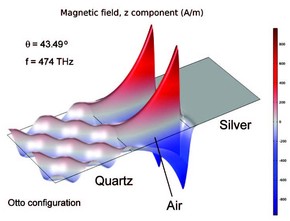
Surface Plasmon Resonance (SPR) is created by surface plasmons, coherent electron oscillations existing between any ...
アプリでシミュレーションを民主化
Veryst Engineering, AltaSim Technologies, および GLL Bio-Med Analytics では, COMSOL Multiphysics® でアプリケーションを構築し, COMSOL ...
音響カモフラージュのための蛾の羽の振動音響特性の調査
ブリストル大学の研究者は音響カモフラージュ特性 を持つ特別な鱗状の羽をモデル化し, 動作中の振動 音響現象をよりよく理解しました. 彼らの研究は他の分野における音響カモフラージュ技術の開発を助けるでしょう.
Doubling Beam Intensity Unlocks Rare Opportunities for Discovery at Fermi National Accelerator Laboratory
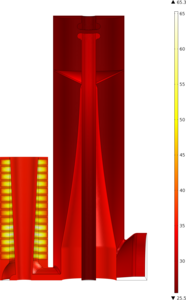
Behind the discovery of the most fundamental and rare physical processes within our universe is powerful technology, ...


