
CEA-MINATEC Uses Simulation to Mitigate Energy Consumption in CO2 Detectors
Serge Gidon
CEA, Leti, Minatec, Grenoble, France
CEA-MINATEC is an international center for micro and nano-technologies which is funded by CEA, a French government-funded technological research organization. One of their current projects is developing silicon-based MEMS CO2 sensors that employ optical detection for monitoring adequate building ventilation.
For the sensor to function, a filament is heated to a specific temperature so that it emits most of its infrared radiation near a specific wavelength. The ambient CO2 absorbs much of this energy while the remaining infrared radiation is detected to allow calculation of CO2. These sensors run at very low current so they will last an extended period of time while costing considerably less than conventional CO2 sensors.
COMSOL Multiphysics is being used to find the optimum geometry for an energy-efficient filament which will avoid hot spots on the freestanding micro hotplate while consuming less energy. A 2D model was used with COMSOL’s ALE (Arbitrary Lagrangian-Eulerian) method to find geometric optimization.
Suggested Stories
Keynote: Democratizing In Silico Ablation R&D via Simulation Apps
In this keynote talk from COMSOL Day: MedTech, Marcela Mercado Montoya of IN SILICO STEM introduces the capabilities ...
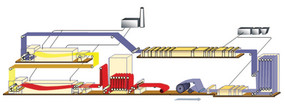
Optimized Heating Process with Uniform Coating
Rautaruukki Oyj supplies metal-based components and systems to the construction and mechanical engineering industries, ...
Better Ways to Heat and Cool Buildings
Adsorptive climate control systems can reduce the power required to heat and cool buildings by running primarily on ...
マルチフィジックスシミュレーションがスマートシティテクノロジーを推進
従来のパワーボックスはかさばり大きすぎます. スペースを意識しモジュール化され, スマートシティでの実装の準備が整ったパワーボックスを設計するとともに, 構造と熱の完全性を確保するために, Raychem RPG ...


