
Optimizing Hematology Analysis: When Physical Prototypes Fail, Simulation Provides the Answers
D. Isèbe
HORIBA Medical, France
Hematology analysis, the analysis of a blood sample to determine a variety of hematological parameters, is a major factor in diagnostic and treatment decisions for blood diseases. Accurate blood analysis requires counting and sorting different cells in a sample to measure their sizes and distributions. HORIBA Medical, a company that supplies medical diagnostic equipment, uses COMSOL Multiphysics to optimize their hematology device designs. One of their devices contains a micro aperture-electrode system for blood to pass through, where electrical impedance and voltage changes between a pair of electrodes are used to count particles. Measurements are difficult to take with experimental prototypes, so researchers at HORIBA relied on COMSOL Multiphysics to model the physical processes inside the system. They accounted for the pressure drop across the aperture, high fluid velocity, heat transfer, and electric fields. Using simulation, they determined that hydrodynamic focusing is a powerful way to improve impedance measurements and therefore device accuracy, and the technique is now used in one of HORIBA's most advanced hematology analyzers.
Suggested Stories
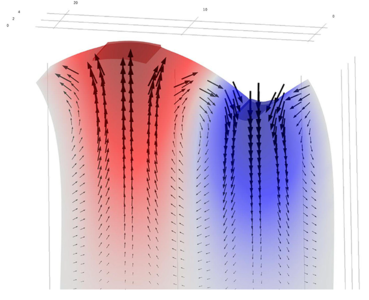
Gaining Insight into Piezoelectric Materials for Acoustic Streaming
Many sensors, such as flow sensors and those used in medical diagnostics, rely on microfluidic devices. However, ...
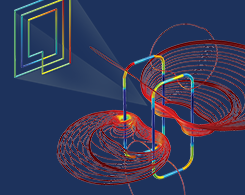
バイオメディカル業界におけるシミュレーションの活用の拡大
インプラントやステントから MRI や脊髄刺激まで, 数値モデリングは生物医学装置の開発にとって最も重要です. 詳細を確認し, この業界の主要なプレーヤーから話を聞いてください.
Enhancing Performance and Safety of Medical Implantable Devices with Multiphysics Simulation
At Abbott, Freddy Hansen uses multiphysics simulation to model left ventricular assist devices (LVADs) to improve the ...
Simulation Advances the Design of a Microfluidic Therapeutic Cell Sorter
The Technology Partnership (TTP), a firm that consults on technology development, created a vortex-actuated cell ...


