
Boston Scientific Simulates Release Mechanisms in Drug-Eluting Stents
T. Schauer, I. Guler
Boston Scientific Corporation, MN, USA
Stent insertion through the coronary artery is a common procedure used to treat restricted blood flow to the heart caused by stenosis. Following the procedure, restenosis may occur due to excessive tissue growth around the stent. Researchers at Boston Scientific are using multiphysics simulation to better understand how drug-eluting stents prevent tissue regrowth and further improve their design.
In COMSOL Multiphysics, the researchers developed a pore-shell model of a stent coating designed for controlled release of medication into surrounding tissues. In their model, the stiff-spring method was implemented to ensure a continuous diffusive flux of medicine at the pore-shell interface. The Optimization Module was used to refine model parameters that could not be determined experimentally, such as the polymer shell thickness and the retardation coefficient of the pores in the stent coating. Both simulation and experimental data confirm a fast release mechanism from pores and slow diffusion through the polymer encapsulant in the shell.
Suggested Stories
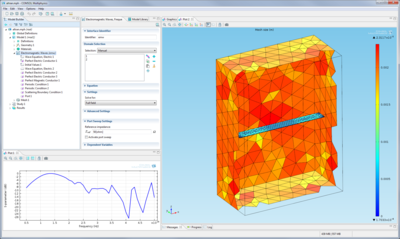
Picking the Pattern for a Stealth Antenna
Stealth airplanes and ships avoid radar detection by optimizing the shape of surfaces to reflect away from the radar ...
超音波トランスデューサーで石油ガス抽出の品質基準を達成
Baker Hughes 社は, 抽出された石油やガスの試験に使用するトランスデューサーを 3D 超音波シミュレーションで最適化することで, 試作コストを 30% 削減しました.
Get an Inside Look at How Veryst Engineering Looks Inside Designs
Step into the material test lab at Veryst Engineering to see how they develop accurate material models for use in ...
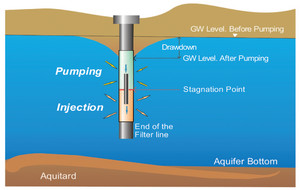
Pumping and Injecting from a Single Borehole
Professor Dr. Martin Sauter leads a group at the University of Göttingen in research on hydrogeology. Cooperating with ...


