
Marco Barink, Erica Coenen, TNO, Netherlands
The advantages of anisotropic properties in 3D printing materials have been difficult to exploit for product design, limited by material manufacturing and production methods. However, additive manufacturing is opening doors to material fabrication, allowing engineers to virtually design varying material properties into a single product. At the Netherlands Organization for Applied Scientific Research (TNO), researchers investigated virtual material design using multiphysics simulation and multiscale modeling.
To develop a procedure for designing anisotropy into 3D-printed structures, the researchers used COMSOL Multiphysics to study mechanical behavior in a unit cell, control material properties and the orientation of anisotropic fibers, and optimize local material distribution to achieve desired overall properties. To study material design on a larger scale, they extracted material parameters from the unit cell to include in a model of a full-scale 3D-printed object, and successfully applied methods of fully-coupled multiscale modeling to geometry and material design in several different applications.
Suggested Stories
Engineering Perfect Puffed Snacks
The production of puffed rice, like many other types of food, is incredibly complicated and involves multiple ...
建設現場にマルチフィジックスシミュレーションを導入
時間, 温度, 材料の選択, 気象条件, および鋳造技術はすべて, コンクリートの初期性能に影響を与える可能性があります. Heidelberg Materials 社は, 十分な情報に基づいた決定を下せるよう, ...
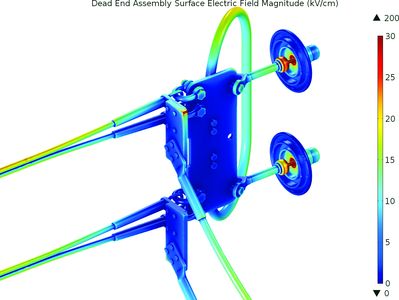
Enhancing Transmission Line Performance: Using Simulation to Optimize Design
Designing power transmission lines requires accounting for many factors: mechanical stress due to environmental ...
Multiphysics Modeling in the Biopharma Industry
Amgen, a leading multinational biopharmaceutical company, produces various drug products that have treated serious ...


