
Marco Barink, Erica Coenen, TNO, Netherlands
The advantages of anisotropic properties in 3D printing materials have been difficult to exploit for product design, limited by material manufacturing and production methods. However, additive manufacturing is opening doors to material fabrication, allowing engineers to virtually design varying material properties into a single product. At the Netherlands Organization for Applied Scientific Research (TNO), researchers investigated virtual material design using multiphysics simulation and multiscale modeling.
To develop a procedure for designing anisotropy into 3D-printed structures, the researchers used COMSOL Multiphysics to study mechanical behavior in a unit cell, control material properties and the orientation of anisotropic fibers, and optimize local material distribution to achieve desired overall properties. To study material design on a larger scale, they extracted material parameters from the unit cell to include in a model of a full-scale 3D-printed object, and successfully applied methods of fully-coupled multiscale modeling to geometry and material design in several different applications.
Suggested Stories
Get an Inside Look at How Veryst Engineering Looks Inside Designs
Step into the material test lab at Veryst Engineering to see how they develop accurate material models for use in ...
Improving Efficiency in Iron Ore Sintering
VDEh-Betriebsforschungsinstitut (BFI) is one of Europe’s leading research institutions in the development of iron- and ...
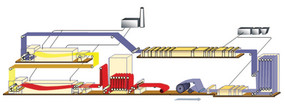
Optimized Heating Process with Uniform Coating
Rautaruukki Oyj supplies metal-based components and systems to the construction and mechanical engineering industries, ...
工場の微調整: 積層造形施設の最適化を支援するシミュレーションアプリ
英国の Manufacturing Technology Centre は, 航空宇宙部門のパートナーと共に, オンサイトの粉末床核融合施設を建設しました. また, ...


