
In accordance with our Quality Policy, COMSOL maintains a library of hundreds of documented model examples that are regularly tested against the latest version of the COMSOL Multiphysics® software, including benchmark problems from ASME and NAFEMS, as well as TEAM problems.
Our Verification and Validation (V&V) test suite provides consistently accurate solutions that are compared against analytical results and established benchmark data. The documented models below are part of the COMSOL Multiphysics® software’s built-in Application Libraries. They include reference values and sources for a wide range of benchmarks, as well as step-by-step instructions to reproduce the expected results on your own computer. You can use these models not only to document your software quality assurance (SQA) and numerical code verification (NCV) efforts, but also as part of an in-house training program.

This example shows how to set up a model of furrow irrigation in a nonuniform soil column. It employs the Unsaturated Dual Permeability feature, which links two Richards' Equations through a fluid transfer function. This scenario can be regarded as a benchmark problem for dual ... 詳細を見る
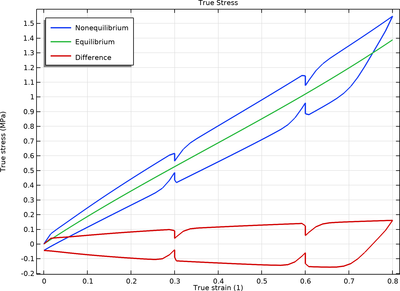
In this example, the Bergstrom–Boyce material model is used to capture the nonequilibrium behavior of carbon-black-filled chloroprene rubber under a strain history that alternates compression with relaxation. Results are verified against experimental and numerical results taken from ... 詳細を見る
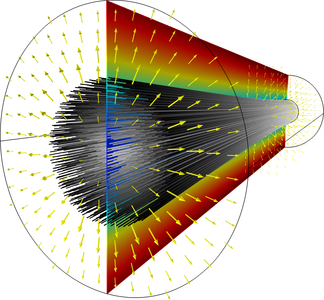
When modeling the propagation of charged particle beams at high currents, the space charge force generated by the beam significantly affects the trajectories of the charged particles. Perturbations to these trajectories, in turn, affect the space charge distribution. The Charged ... 詳細を見る

Plasma discharges containing chlorine are commonly used to etch semiconductors and metals in microelectronics fabrication. This tutorial model studies chlorine plasma discharges using a global (volume-averaged) diffusion model. Global diffusion models can run simulations in a fraction ... 詳細を見る

This benchmark studies the nonlinear deformation of a spherical cap subjected to point load at center using 2D axisymmetric Solid Mechanics and Shell interfaces. The results from the Shell interface are compared with Solid Mechanics interface as well as with analytical results given in ... 詳細を見る
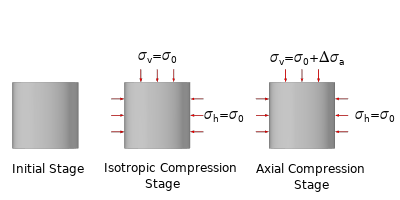
In this example, monotonic and cyclic triaxial tests are simulated using the Hardening Soil Small Strain material model. The model captures the effects of small strain stiffness and hysteresis under cyclic loading. The stress-strain relationship matches the hyperbolic curve reported in ... 詳細を見る
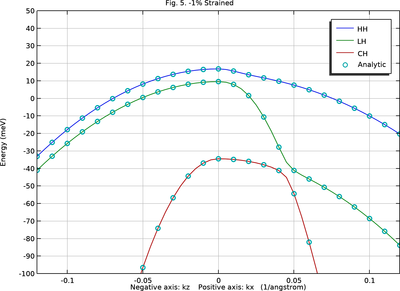
This benchmark model computes the valence band structure of an unstrained and a strained bulk GaN wurtzite crystal, as a tutorial for users who wish to set up multiple wave function components with the Schrödinger Equation interface. The model follows the formulation given in the ... 詳細を見る
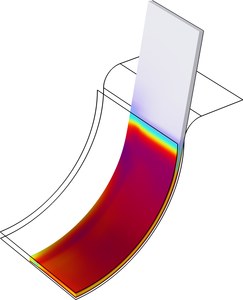
This example benchmarks a NAFEMS validation model of a friction contact problem with an elastoplastic material model. A thin metal sheet is forced into a die by a punch. Both the compressing displacement and the release of the punch are modeled in order to compute the forming angle (at ... 詳細を見る

This model shows a setup of two parallel wires with a constant current running through both. Their cross-sections are successively reduced until a set force per unit length is reached. 詳細を見る

The Bessel panel is a way to arrange a number of loudspeakers so that the angular sound distribution resembles that of a single speaker. This model combines five Bessel panels in the same pattern to approximate a purely radial sound field. The speakers are driven with different ... 詳細を見る


