HPC and Cloud

Scale Beyond the Desktop

HPC in the COMSOL Multiphysics® software empowers engineers to solve high-fidelity multiphysics models that are otherwise impossible to solve on a single workstation. Due to hybrid parallel processing, simulations can be scaled from a local multicore machine to massive HPC clusters and cloud environments.

  • Solve Memory-Constrained Models: Overcome the physical RAM capacity limits of local workstation by distributing the computational load across a cluster. This solution makes it possible to build and solve large, coupled multiphysics systems without compromising on mesh refinement and accuracy.
  • Accelerated Time to Solution: Drastically shorten computation cycles from days to hours. COMSOL Multiphysics® includes a broad suite of parallelized direct and iterative solvers to efficiently distribute numerical workloads, enabling rapid design iterations on even the most complex, coupled simulations.
  • High-Throughput Engineering: Expand the scope of design exploration by using the trivially parallel nature of parametric sweeps to run iterations concurrently on distributed resources. This high-efficiency scaling makes dense design-space mapping feasible within standard project cycles.
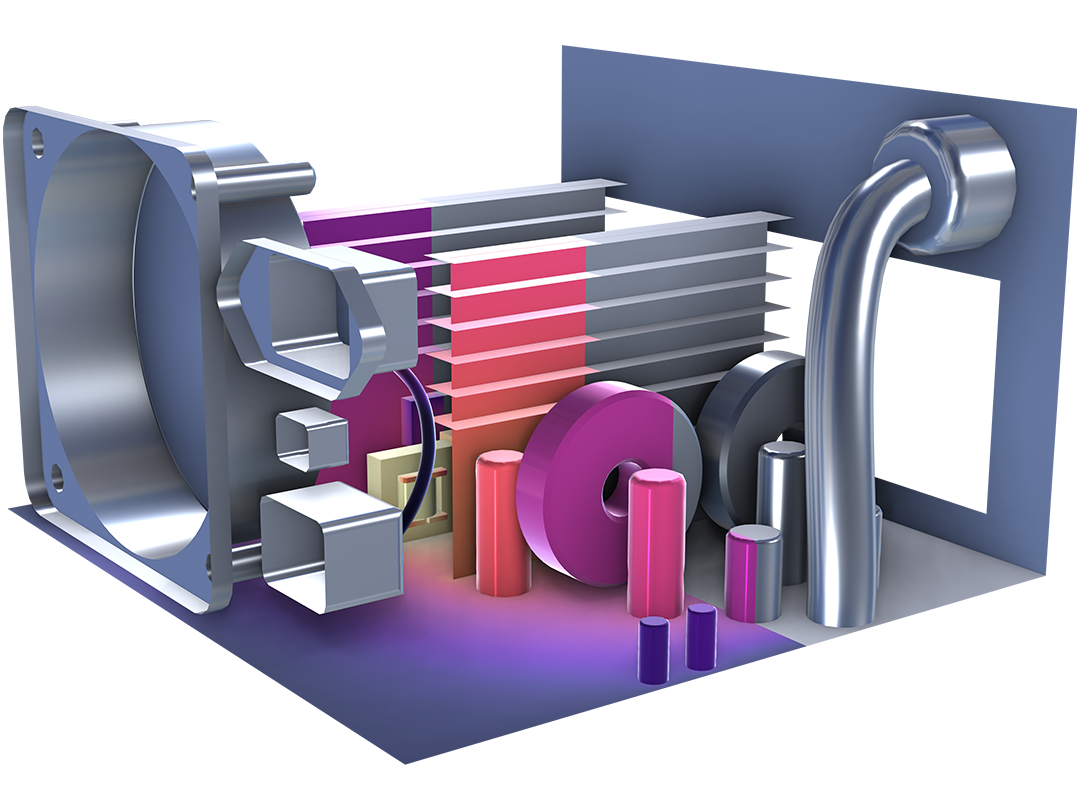
A computer power supply unit showing the temperature.

The Foundation: Scalable Architecture

COMSOL Multiphysics® features a cluster-aware architecture that scales from local workstations to enterprise HPC environments and clouds. Following a one-time cluster configuration, the software automatically optimizes numerical workloads for a specific hardware. This ability enables engineers to transition from desktop prototyping to large-scale production runs without manual changes or repetitive cluster tuning.

Multicore or Multiprocessor Scaling (Shared-Memory Parallelism)

Take advantage of the full power of a workstation's hardware out of the box. COMSOL Multiphysics® uses shared-memory parallelism (via OpenMP®) to automatically distribute computational tasks over all available processor cores. This automatic parallelization means immediate performance gains for large high-fidelity models without the need for any software configuration. For shared-memory parallelism on a single computer, no additional license fees are required to run on an unlimited number of processor cores.

High-Performance Scaling (Distributed-Memory Parallelism)

Scale beyond the physical limits of a single machine by leveraging the pooled resources of a cluster. With a floating network license (FNL), no additional license fees are required to run on a cluster of unlimited size. By using MPI to partition a model’s memory footprint and computational load across multiple nodes, COMSOL Multiphysics® can perform high-fidelity simulations with hundreds of millions of degrees of freedom (DOFs). This capability enables users to run extensive mesh refinements or solve large, complex multiphysics models, as long as sufficient cluster hardware is available.

Maximizing Hardware Efficiency (Hybrid Memory Parallelism)

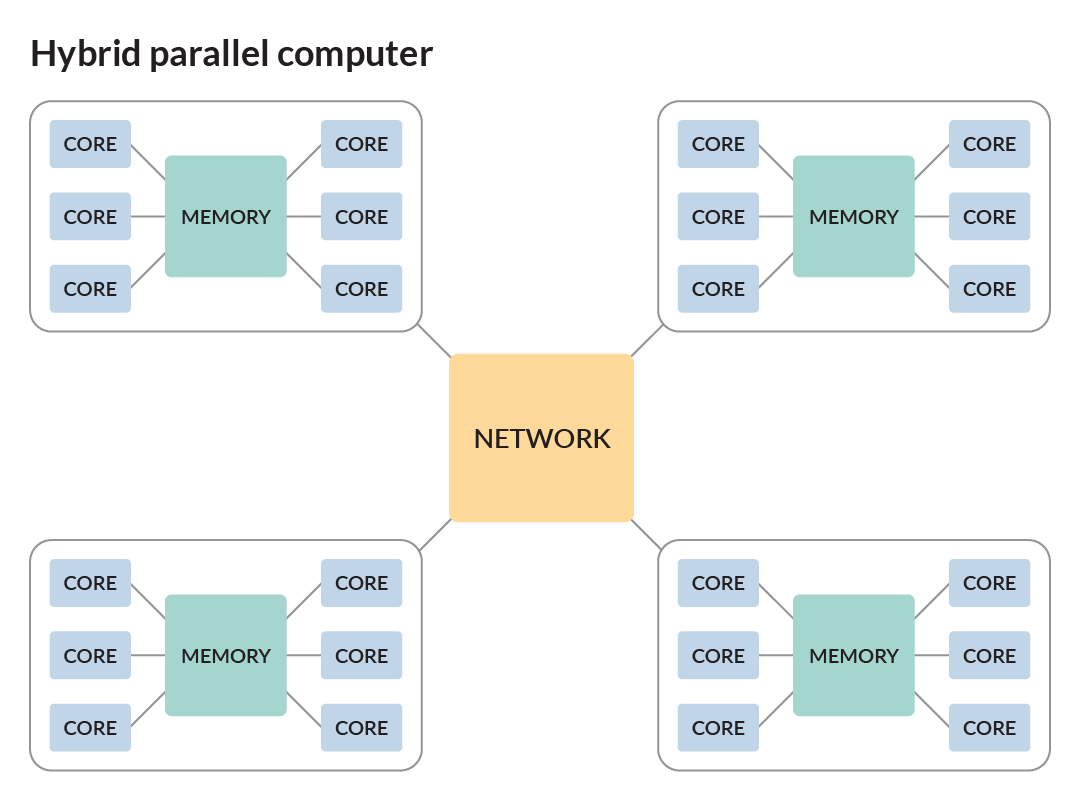
Maximize computational throughput by combining shared and distributed memory strategies. By balancing multithreading (via OpenMP®) within individual nodes and message passing (MPI) across a cluster, COMSOL Multiphysics® minimizes network communication overhead and optimizes hardware utilization. This hybrid approach ensures that simulations scale efficiently on modern many-core architectures, providing faster turnaround times and predictable performance across massive compute resources.
Advanced Solver Technologies

COMSOL Multiphysics® features a fully parallelized solver technology where both the assembly process and the linear solvers operate in a distributed fashion. This technology ensures that every stage of the simulation, from building the matrix to reaching convergence, uses the full power of the cluster.

Parallel Direct Solvers: For numerically challenging physics models, such as highly coupled multiphysics systems, COMSOL Multiphysics® provides distributed-memory direct solvers that pool RAM across the cluster to solve models exceeding single-node capacity. Supported solvers include:

  • MUMPS
  • PARDISO for Clusters (Intel® oneAPI Math Kernel Library (oneMKL), formerly IntelMKL)
  • The NVIDIA® direct sparse solver (cuDSS)

Iterative Solvers: To handle physics models requiring tens to hundreds of millions of DOFs, COMSOL Multiphysics® utilizes a suite of parallel iterative solvers designed for maximum memory efficiency. Optimized implementations are available for:

  • Iterative solvers:
    • BiCGStab
    • CG
    • GMRES
    • FGMRES
  • Smoothers and preconditioners
  • Multilevel methods:
    • Geometric multigrid (GMG)
    • Algebraic multigrid (AMG)
  • Domain decomposition solvers

Beyond linear algebra, COMSOL Multiphysics® also parallelizes the matrix assembly and constraint handling, significantly reducing the setup time.

High-Throughput Computing: Managing Parallel Parametric Sweeps

High-throughput computing enables rapid design exploration by shifting the focus from solving a single massive model to evaluating thousands of parameter variations concurrently. On HPC infrastructure, COMSOL Multiphysics® offers several distinct task-parallelism capabilities. The Batch Sweep node leverages native scheduler integration, such as SLURM® or LSF®, to spawn separate batch jobs for different parameter values, ensuring that a single nonconverging variation does not halt the entire study. Alternatively, a Distributed Parametric Sweep bundles multiple concurrent parameter evaluations into a single large MPI job, which can be highly efficient for bypassing long scheduler queue times when deploying across a distributed system.

This high-throughput capability is not limited to cluster environments. For users operating on local multicore workstations, the Batch Sweep feature brings task parallelism directly to the desktop. As a result, it is possible to solve multiple parameter sets concurrently by maximizing local hardware utilization, providing a method for smaller-scale design mapping before transitioning to a cluster.

A third option is to run completely independent COMSOL Multiphysics processes on a cluster, with each process handling a separate model, parameter set, or simulation scenario. This approach is well suited for loosely coupled workloads where each run can proceed independently, and it gives users full control over job submission, monitoring, and results evaluation through scripts or external tools. With an FNL, this workflow can scale to large numbers of design variations of the same model without additional license fees based on cluster size or core count.

These parallel sweep technologies serve as the engine for machine learning (ML) workflows, specifically synthetic data generation in the Surrogate Model Training study. By rapidly mapping design spaces across local or cluster hardware, engineers can compile massive, ground-truth datasets to train surrogate models such as deep neural networks (DNNs).

User Experience: Desktop to Cluster Integration

Seamless User Interface (UI) Submission

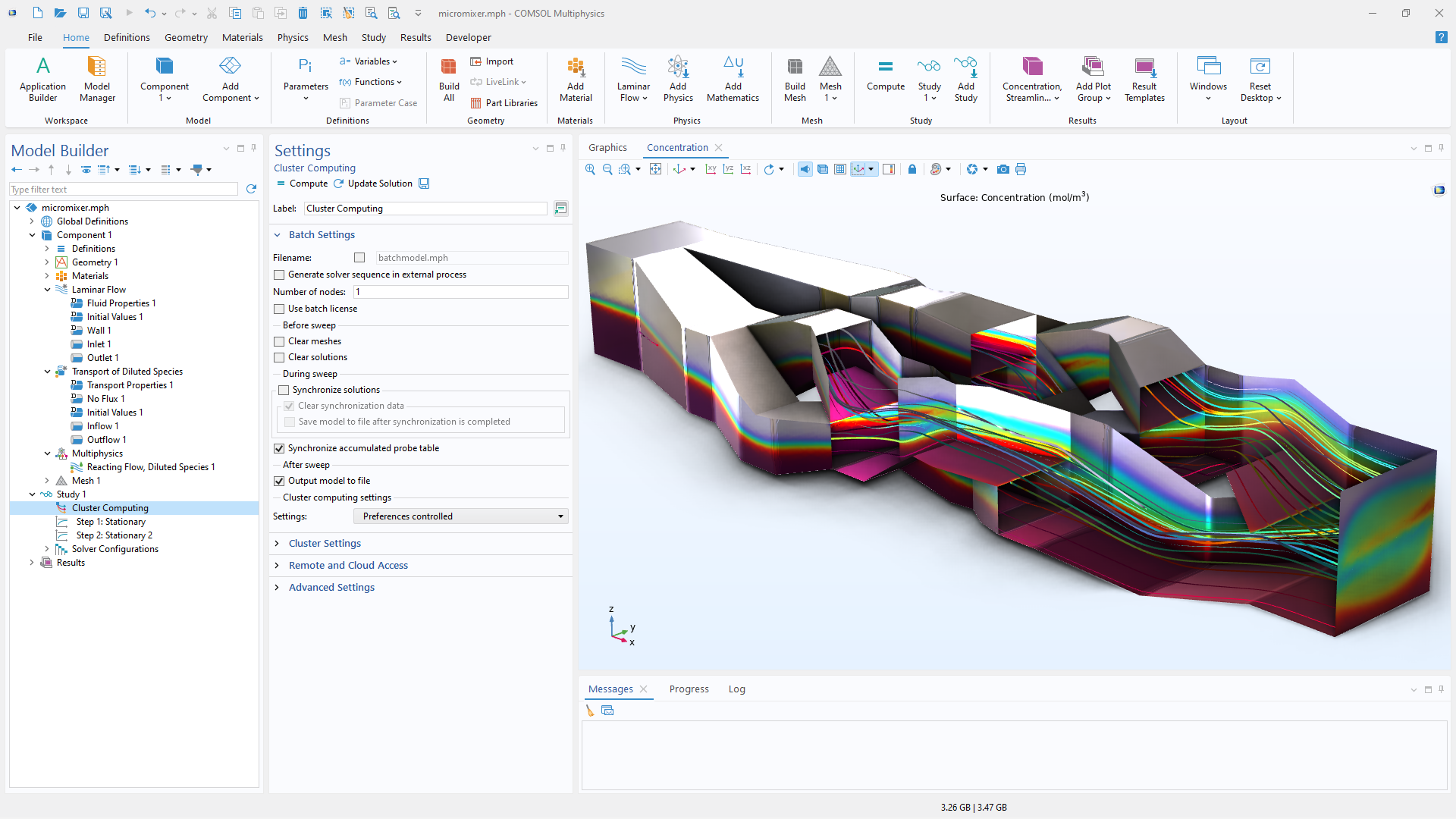
The workflow for submitting and starting cluster jobs directly from the COMSOL Multiphysics® UI is designed for engineers who want the power of a cluster without leaving the familiar UI. Through the Cluster Computing or Cluster Sweep nodes in the Model Builder, COMSOL Multiphysics® automatically transfers the model from a local machine to a cluster, submits the cluster job by interfacing with a scheduler (SLURM®, PBS, LSF®, Grid Engine, and Microsoft® HPC Pack), and retrieves the result. A cluster job can be submitted from the COMSOL® UI on a local machine, making it possible for the UI to track the job's status. Users can then detach the UI from the running cluster job, allowing the job to continue independently, and then later reattach the UI to monitor solver progress or access the completed dataset.

Command Line Batch Calls

For power users managing extreme-scale models or automated pipelines, COMSOL Multiphysics® supports fully headless batch execution directly from the command line. By submitting .mph files as batch commands, the UI can be bypassed entirely, enabling deep integration into broader, automated HPC pipelines or custom shell scripts. This scriptable approach provides maximum data efficiency, making it ideal for scenarios where transferring massive output datasets back to a local client is impractical. Ultimately, headless execution ensures that the model, the computation, and the resulting terabytes of data remain entirely within the high-speed cluster storage environment.

Cloud Computing Compatibility

Many users run simulations in the cloud to access scalable, on-demand computing resources without maintaining their own HPC infrastructure. Users with an FNL can use the license on the cloud platform of their choice.

COMSOL models can be deployed on major cloud providers such as AWS®, Azure®, and Google Cloud, as well as through HPC cloud platforms and partners such as Rescale and Nimbix. Users also have the option to run the software with Amazon Elastic Compute Cloud™ (Amazon EC2™). More information is available on the HPC partners pages.

Amazon Web Services, the “Powered by Amazon Web Services” logo, and Amazon EC2 are trademarks of Amazon.com, Inc. or its affiliates in the United States and/or other countries. Intel is a trademark of Intel Corporation in the U.S. and/or other countries. LSF is a registered trademark of International Business Machines Corporation. Microsoft, Windows, and Windows Server are either registered trademarks or trademarks of Microsoft Corporation in the United States and/or other countries. NVIDIA, CUDA, and RTX are trademarks and/or registered trademarks of NVIDIA Corporation in the U.S. and/or other countries. The OpenMP name and the OpenMP logo are registered trademarks of the OpenMP Architecture Review Board. SLURM is a registered trademark of SchedMD LLC. COMSOL AB and its subsidiaries and products are not affiliated with, endorsed by, sponsored by, or supported by these trademark owners.

シミュレーションのニーズはそれぞれ異なります.

ソフトウェアがお客様の要件を満たすかどうかを十分に評価するには, 当社までお問い合わせください. 営業担当者とご相談いただくことで, お客様の目的に合わせた推奨事項や, 評価を最大限に活用するための文書化されたモデル事例などをご提供します. お客様のニーズに最適なライセンスオプションの選択をサポートします.

"COMSOL へお問い合わせ" ボタンをクリックしてください. 連絡先情報, 具体的なご意見やご質問をご入力のうえ送信してください. 1営業日以内に営業担当者よりご連絡いたします.

次のステップ:

ソフトウェアデモをリクエスト