Development of a High-Mach-Number CFD Model for Neutral Gas Injection in Pegasus-III
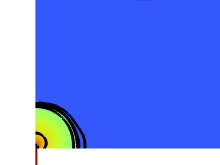
Transient coaxial helicity injection (CHI) is a promising plasma startup technique for spherical tokamaks that relies on controlled delivery of neutral deuterium gas and electromagnetic energy into the vacuum vessel. As part of a broader effort to develop a multi-physics digital twin of transient CHI experiments on the Pegasus-III spherical tokamak at the University of Wisconsin - Madison, a transient computational fluid dynamics (CFD) model has been developed to investigate gas transport from the fueling system into the tokamak chamber. The model was implemented in COMSOL Multiphysics® using the High Mach Number Flow, k-ε turbulence interface from the CFD Module in a 2D axisymmetric geometry representing the gas plenum, converging nozzle, injection pipe, and vacuum chamber. Simulations examined the transient expansion of deuterium gas from a 31.4 cc plenum initially pressurized at 5000 Torr into a ~0.5 m3 chamber with background pressure 10-4 Torr. Injector configurations with both 25 cm and 100 cm pipe lengths were investigated to quantify the influence of injector geometry on gas delivery and chamber filling dynamics. Because the background chamber pressure is several orders of magnitude below atmospheric conditions, local Knudsen numbers were evaluated throughout the computational domain to assess the validity of a continuum fluid description. The resulting Knudsen-number distributions indicate that the dominant flow structures governing gas delivery remain within the continuum or transitional-flow regimes over most of the injector and near-field chamber regions, supporting the use of the High Mach Number Flow formulation for this application. Simulation results provide time-resolved predictions of pressure evolution within the plenum, injection pipe, and vacuum chamber, as well as mass-flow delivery rates at multiple axial locations. The injector nozzle was found to regulate the peak gas throughput to approximately 1800 Torr·L/s under the operating conditions considered. Comparison of the 25 cm and 100 cm injector configurations demonstrates that pipe length strongly influences gas transport delay and the temporal evolution of chamber filling while producing smaller changes in nozzle-limited peak flow rate. Pressure contour visualizations reveal the propagation of the neutral gas pulse from the injector into the chamber and provide insight into the spatial distribution of gas available for subsequent plasma formation. These results establish a validated neutral-gas transport framework that can be used to guide fueling system design and interpret future experimental measurements. Future work will extend the model toward a comprehensive multi-physics representation of Pegasus-III startup physics by coupling neutral gas transport with electromagnetic, plasma-formation, and magnetohydrodynamic models. Although developed for Pegasus-III, the neutral-gas transport methodology is readily transferable to larger spherical tokamak configurations and could ultimately support studies of fueling and startup strategies for future devices. The model was developed independently and does not utilize Application Library examples.