
Heating Ramp Control in a Modular Furnace with Rotating ON/OFF Burners
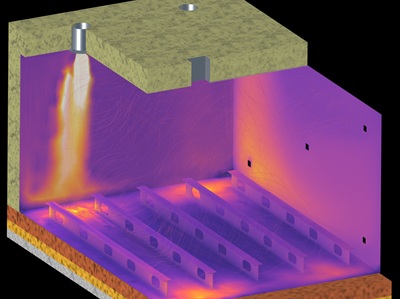
In long industrial furnaces equipped with multiple ON/OFF burners, achieving a prescribed heating ramp while maintaining acceptable temperature uniformity is challenging because radiation and forced convection interact with strongly time-dependent heat input. This work presents a COMSOL Multiphysics modelling strategy for a representative central module of a modular furnace, aimed at reproducing heating ramp with subsequent stabilization phase using a realistic burner-cycling strategy. The model is based on transient heat transfer in solids and fluids coupled with surface-to-surface radiation, while combustion is represented through an effective flame boundary condition. Each burner is modelled by imposing a high-temperature boundary on the burner outlet surface, blended with the local roof temperature through a smoothed activation function to avoid numerical stiffness. To reduce computational cost, the flow field is not solved transiently: multiple steady CFD solutions (one per burner operating condition) are precomputed and reused as imposed velocity fields in the transient thermal study. A fixed ignition schedule is enforced, with four burners rotating within a cycle time, while the effective ON-time is adjusted by a PID-like control signal derived from a temperature probe tracking the reference ramp. Under the assumption of synchronized operation among modules, criticalities include convergence degradation and timestep collapse due to discontinuous switching under strong radiative nonlinearity. These are addressed by formulating the control logic through time-dependent variables and conditional switching between activation functions with different effective ON-durations, combined with smooth regularization of boundary transitions and timestep management. The resulting workflow enables stable time-dependent simulations of burner cycling and provides a practical basis for evaluating control strategies during ramp-up and stabilization with a physics-based model.
ダウンロード
- 18401_final_poster.pdf - 1.46MB


