
In silico modelling of a long-term implantable continuous blood glucose monitor
Implantable continuous glucose monitoring systems are an emerging technology in diabetes management. Developing a device that incorporates such a sensor requires extensive experimental testing in a regulated medical-device environment to inform design decisions, optimise sensor performance, and maximise operational lifetime. This process also demands the controlled manufacture of multiple sensor variants for systematic evaluation. In silico modelling provides an effective approach to accelerate development while reducing both experimental effort and manufacturing burden.
The objective of this work was to develop a computationally efficient model to predict the longevity of an enzyme-based, electrochemical implantable continuous blood glucose monitor (CBGM) and to identify the critical design parameters governing its performance.
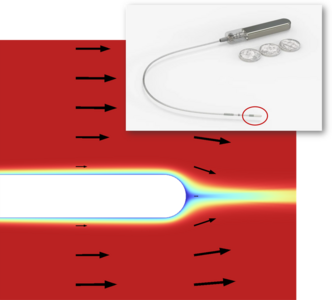
The model was developed in COMSOL Multiphysics. For computational efficiency, the main model was one-dimensional, but it was informed by: (1) a two-dimensional CFD model of blood flow, used to obtain appropriate boundary conditions for the depletion layer of each species, reaction-rate constants at the electrode, and transport parameters for glucose, oxygen, and hydrogen peroxide in solution; and (2) in vitro experimental data, including glucose and H2O2 stepping and O2 reduction measurements, used to estimate transport parameters for glucose, oxygen, and hydrogen peroxide across the sensor layers.
The Glucotrack CBGM demonstrated a simulated longevity of at least 2.5 years, as determined by the major limiting factor of retained enzyme activity. The model also enabled rapid identification of critical relationships between key sensor design parameters and the cascade of processes occurring within the glucose sensor.
Overall, the model provides valuable insight into implantable continuous glucose sensor longevity and offers a versatile tool for investigating design trade-offs and optimising the performance of long-term glucose sensors.
ダウンロード
- 19371_final_poster.pdf - 0.58MB
- 14 - Justin Buckland.pdf - 0.86MB


