
Numerical Analysis of Solder Joint Corrosion in Photovoltaic Modules
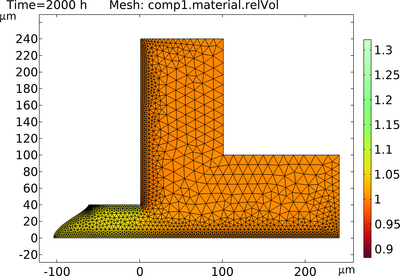
Photovoltaic (PV) modules are exposed to harsh environmental conditions throughout their service life, including temperature fluctuations, humidity, wind loads, and solar irradiation. These stressors promote degradation mechanisms that reduce module efficiency and long-term reliability. Among them, corrosion of solder joints at the interconnections between busbars and silver contacts is of particular importance, as it decreases the effective contact area, increases electrical resistance, and thereby impairs module performance. This work investigates the corrosion of solder material at these contact interfaces using COMSOL Multiphysics. The aim is to assess the suitability of an FEM-based approach for describing corrosion mechanisms in PV interconnections and for estimating their temporal progression. In addition, parameter studies were performed to evaluate the influence of electrolyte film thickness, both with and without transport of diluted species (TDS), using film thicknesses of 50 µm, 100 µm, and 150 µm. The simulations yield plausible results and predict a solder material loss that is qualitatively consistent with comparable values reported in the literature. Furthermore, the model indicates faster corrosion near the silver electrode than near the copper electrode, consistent with experimentally observed trends from EDX mapping (see Figures 1 and 2). In contrast, varying the electrolyte film thickness only caused minor changes in material loss of approximately 1–1.5 µm over 2000 h, suggesting that other limiting mechanisms may dominate the corrosion kinetics. Overall, the results demonstrate that the proposed FEM approach is suitable for the qualitative investigation of corrosion processes in PV solder joints, while further studies are required for improved parameterization and quantitative accuracy.
ダウンロード
- 17551_final_poster.pdf - 1.09MB


