
Numerical Modeling of Resistance Spot Welding
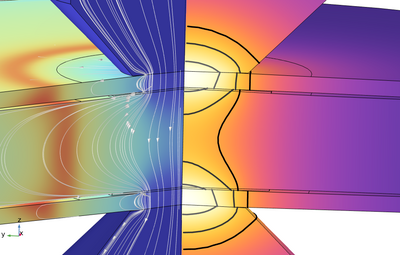
This work describes a multiphysics numerical model using Comsol Multiphysics® for the simulation of resistance spot welding (RSW), a widely used joining process in high-volume manufacturing industries. The objective is to improve the understanding and prediction of weld formation by capturing the coupled electrical, thermal, and mechanical phenomena involved during the process. The model is based on a finite element formulation that describes Joule heating due to current flow, heat transfer within the sheets and electrodes, and the resulting thermo-mechanical response of the materials. Particular attention is given to the treatment of contact interfaces, where electrical and thermal resistances evolve as a function of pressure, temperature, and surface conditions. These interface effects strongly influence local heat generation and, consequently, the initiation and growth of the weld nugget.
Temperature-dependent material properties are considered, along with phase transformation effects associated with melting and solidification. A fully coupled resolution strategy is implemented to handle the nonlinear interactions between the different physical fields, ensuring numerical stability and consistency. The simulation results are validated through comparison with experimental measurements of the Heat Affected Zone (HAZ) dimensions. The agreement obtained supports the reliability of the approach in reproducing the main features of the process. In addition, parametric analyses are performed to evaluate the influence of current intensity, welding time, and electrode force on weld quality.
The proposed framework offers a predictive tool for analyzing and optimizing resistance spot welding operations. It can be used to reduce reliance on trial-and-error experimentation and to support process design in industrial contexts.
ダウンロード
- 18671_final_paper.pdf - 0.84MB


