
Shape Optimisation of a dielectric resonator for Pentacene-doped p-terphenyl Maser
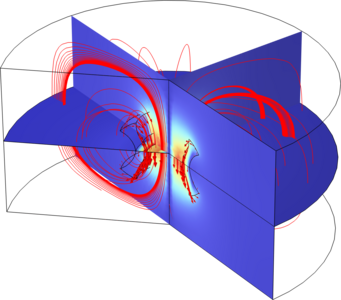
This project investigates the geometry optimisation of a dielectric resonator for a pentacene-doped p-terphenyl maser (microwave amplification by stimulated emission of radiation). Efficient operation of an organic crystal maser requires strong microwave magnetic field coupling between the resonant cavity mode and the spin-active gain medium[1]. The primary design challenge is therefore to maximise magnetic field confinement within the gain medium while maintaining resonance at the required maser transition frequency (~1.45 GHz) (Figure 1). This work employs COMSOL Multiphysics® version 6.3 to develop an inverse design approach for improving dielectric resonator performance through shape optimisation.
The simulations were performed using the RF Module and the Optimisation Module with a 2D axisymmetric model. The electromagnetic response was solved using the Electromagnetic Waves, Frequency Domain interface, and resonant modes were obtained from eigenfrequency studies. The optimisation aimed to maximise microwave magnetic field confinement within the gain medium, and the process was guided by a Purcell factor surrogate, with the magnetic filling factor selected as the objective function[2,3]. The magnetic filling factor is defined as the ratio of the magnetic energy within the gain region to the total magnetic energy and therefore provides a direct measure of magnetic field localisation[2,4].
Shape optimisation was carried out on the dielectric resonator cross-section using the Deformed Geometry, Free Shape Domain, Polynomial Boundary, Symmetry/Roller, and Mirror Symmetry features available in the COMSOL Shape Optimisation Module. Different initial dielectric geometries, including polygonal cross-sections with varying numbers of edges, were investigated (Figure 2). Despite the different starting geometries, the optimisation consistently converged towards similar non-circular dielectric shapes that improved magnetic field concentration around the gain medium, indicating a robust optimisation trend rather than a geometry-dependent solution.
The optimisation increased the magnetic filling factor from 0.53 to 0.77, corresponding to an improvement of approximately 45%, demonstrating substantially enhanced magnetic field confinement within the gain medium. Therefore, the results show that COMSOL based shape optimisation can systematically identify dielectric resonator designs with improved microwave magnetic field confinement, providing a useful design route for compact organic crystal masers. By enhancing the light-matter interaction between the resonant microwave mode and the spin-active gain medium, the optimised resonator could improve the efficiency of stimulated microwave emission and reduce the threshold for room temperature maser operation (Figure 3).
ダウンロード
- 18802_final_poster.pdf - 0.61MB


