
A Research Team Uses Simulation to Challenge a 150-Year-Old Theory
Juan Carlos Miñano and Dejan Grabovičkić
Cedint Polytechnic University of Madrid
Spain
The idea of "perfect imaging", that is a resolution less than the wavelength of light producing the image, was first proposed in the mid-19th century by famed Scottish physicist James Clerk Maxwell. For the next 150 years, it was widely believed that such was impossible due to the fact that light diffracts around points that are the same size or smaller in wavelength. Then, in 2009, Ulf Leonhardt, of the University of St. Andrews in Scotland, theoretically analyzed the phenomenon and demonstrated its focus was not restricted by the diffraction limit.
A research team at the Cedint Polytechnic University of Madrid used simulation to demonstrate Leonhardt’s proposal and prove that diffraction limits can be surpassed. The team proposed using a device to do this, which they called a spherical geodesic waveguide (SGW).
Using COMSOL Multiphysics and the RF Module, the research team was able to demonstrate that these SGWs could be manufactured for certain applications such as microwaves. Their next goal is to design a dielectric SGW that will work in the visible spectrum.
Suggested Stories
On the Cutting Edge of Hearing Aid Research
Nearly 20% of the United States population has some degree of hearing impairment. Despite the relative ...
建設現場にマルチフィジックスシミュレーションを導入
時間, 温度, 材料の選択, 気象条件, および鋳造技術はすべて, コンクリートの初期性能に影響を与える可能性があります. Heidelberg Materials 社は, 十分な情報に基づいた決定を下せるよう, ...
When it’s Impossible to Take Actual Measurements, Multiphysics Provides the Answers
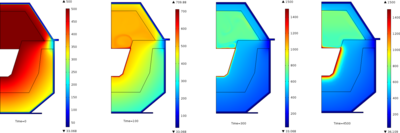
To contain splashes and provide protection at plants where metal is fabricated, blast furnace runners need a roof made ...
マルチフィジックスモデリングを通してブリルアンオプトメカニカルインタラクションを理解する
Campinas 大学とCorning の研究者は, 光弾性と移動境界効果がどのように連携して導波ガイド, 光ファイバー, その他のナノフォトニック構造におけるブリルアン散乱を増強(または抑制)させるかを見たいと考えていました. ...


