
A Research Team Uses Simulation to Challenge a 150-Year-Old Theory
Juan Carlos Miñano and Dejan Grabovičkić
Cedint Polytechnic University of Madrid
Spain
The idea of "perfect imaging", that is a resolution less than the wavelength of light producing the image, was first proposed in the mid-19th century by famed Scottish physicist James Clerk Maxwell. For the next 150 years, it was widely believed that such was impossible due to the fact that light diffracts around points that are the same size or smaller in wavelength. Then, in 2009, Ulf Leonhardt, of the University of St. Andrews in Scotland, theoretically analyzed the phenomenon and demonstrated its focus was not restricted by the diffraction limit.
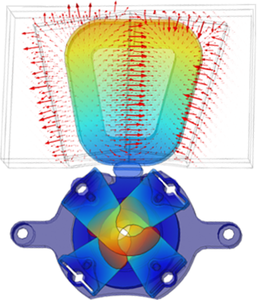
A research team at the Cedint Polytechnic University of Madrid used simulation to demonstrate Leonhardt’s proposal and prove that diffraction limits can be surpassed. The team proposed using a device to do this, which they called a spherical geodesic waveguide (SGW).
Using COMSOL Multiphysics and the RF Module, the research team was able to demonstrate that these SGWs could be manufactured for certain applications such as microwaves. Their next goal is to design a dielectric SGW that will work in the visible spectrum.
Suggested Stories
Get an Inside Look at an Innovative Rainwater Drainage System
Step into a busy neighborhood in Copenhagen, Denmark, to see how a multidisciplinary urban planning team used ...
カーオーディオシステムの設計に役立つシミュレーションアプリケーション
高級車用のオーディオエンターテイメントシステムはエンドユーザーに最高品質の車内リスニング体験を提供する必要があります. HARMAN International ...
電磁気学の概念の背後にある物理学とアプリケーション
電気工学の学生は彼らが学んでいる電磁気の概念を視覚化することは困難だと感じます. この問題を解決するために Virginia ...
Keeping Cool: SRON Develops Thermal Calibration System for Deep-Space Telescope
Deep-space telescopes require ultrasensitive detectors and calibration to pick up weak far-infrared signals. The SpicA ...


