
Lorenzo Bortot, CERN, Switzerland
Engineers and physicists at CERN go to great lengths to ensure that the high-power superconducting magnets that maintain the circular trajectory of particles inside the Large Hadron Collider (LHC) do not revert to a resistive state, an event known as a quench. To understand and prevent quench events, Lorenzo Bortot, an electrical engineer and research fellow at CERN, used numerical simulation to develop a multiphysics, multiscale, and multirate representation of the electrodynamics and thermal evolution of a quench event.
Suggested Stories
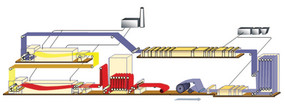
Optimized Heating Process with Uniform Coating
Rautaruukki Oyj supplies metal-based components and systems to the construction and mechanical engineering industries, ...
Multiphysics Analysis Helps Preserve the Past
Jos van Schijndel is the founder of Netherlands-based consulting firm CompuToolAble and assistant professor at ...
ダリエス水車で発電し魚を守る
Physixfactor社は, シミュレーションを利用して, オランダの沿岸部の洪水対策に使用する水車タービンの設計をシミュレーションで行いました. 従来の水力発電用タービンと比較して, 新しいタービン設計では魚の死亡率が20%から1 ...
Behind the Rumble and Roar of Mahindra Motorcycles
Optimization is a subtle and delicate art, especially when it comes to motorcycles. Regulatory requirements on pass-by ...


