
J. Morgan, R. Greegor, P. Ackerman, Q. Le
Boeing, WA, USA
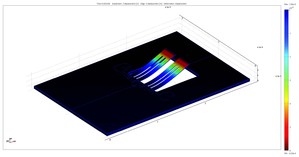
Carbon fiber composites are used extensively throughout the body of modern aircraft, such as the Boeing 787 Dreamliner, because of their exceptional strength and light weight. Expanded metal foil (EMF) is added to the composite structure layup as a protective measure to dissipate the extreme heat and current generated by a lightning strike. Engineers at Boeing Research and Technology (BR&T) are using multiphysics simulation and physical measurements to ensure that protective coatings on the EMF remain intact when subjected to thermal stress arising from the ground-to-air flight cycle. The impact of the EMF design parameters on stress buildup and displacement in each layer of the composite structure layup was evaluated in COMSOL Multiphysics®. Experiments correlated well with simulation results, which confirmed that designs characterized by lower displacements also have a reduced likelihood of crack formation.
Suggested Stories
Increasing Productivity and Revenue with Computational Applications
HeatSinkSim is a simulation app created by the specialists at AltaSim Technologies that can help optimize heat sink ...
Simulation Summit Panel: The Multiphysics Roadmap
Speakers from NVIDIA, Stanford University, and MathWorks, as well as COMSOL and moderator DE 24/7, discuss the future ...
Keynote: Multiphysics Modeling in AR & VR Innovation
Meta is working to advance the optical and display technologies for its augmented reality (AR) and virtual reality ...
Easy and Accurate Measurement of Blood Viscosity
Microvisk Technologies develops and manufactures devices for measuring blood viscosity using the power of Micro ...


