
Continuous Casting: Optimizing Both Machine and Process with Simulation
N. Grundy
SMS Concast, Switzerland
The process of continuous casting has transformed steel production, saving valuable resources while improving steel quality and process efficiency. Continuous casting involves carrying molten refined steel to a caster. There, water-cooled copper molds are used to form steel strands that are cut and then cooled. High-quality steel production requires minimizing the presence of non-metals in the steel, improving the microstructure, and maintaining even composition by reducing the segregation of alloying elements. Engineers at SMS Concast, a Switzerland-based company specializing in continuous casting technology, have used COMSOL Multiphysics to model mechanical deformations, the fluid motion present as molten steel flows into the molds, and the cooling process. Using their simulations, they have studied coupled physics that would be impossible to model otherwise – such as the heat transfer during initial solidification and the electromagnetic fields generated by stirring equipment.
Suggested Stories
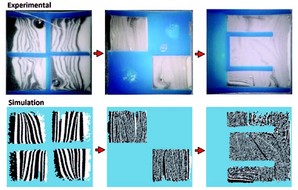
Modeling of Laminar Flow Static Mixers
Veryst Engineering, a company that provides consulting in engineering design and product manufacturing, has ...
MTC Develops Simulation App to Revolutionize Design for Additively Manufactured Parts
Tolerances and precision in the aerospace industry are astoundingly tight. Because of the high degree of regulation ...
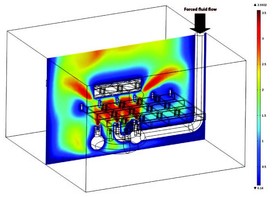
Conjugate Heat Transfer
This is an application brief describing the concept of Conjugate Heat Transfer, which is important in many industrial ...
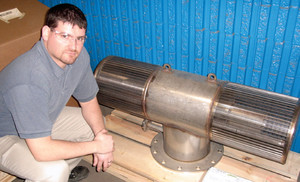
The Science of Water Screening
Johnson Screens® are the manufacturers of steel screens that impede debris from lakes and rivers from entering pipes ...


