
W. Lee, K. Jensen
MIT, MA, USA
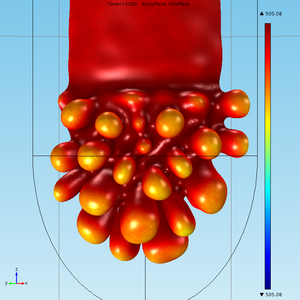
The chemical reactions used to generate solvents and certain pharmaceuticals rely on organic synthesis, a process of combining individual chemicals that can be accelerated through microwave heating. A microreactor system facilitates the direct, localized, and efficient temperature change necessary for successful synthesis. However, a uniform temperature distribution is crucial to the chemical process, and these reactions can be inhibited by unwanted temperature changes or heating that occurs too slowly. Wen-Hsuan Lee, a researcher at the Massachusetts Institute of Technology (MIT), fabricated a borosilicate glass microreactor to conduct this microwave organic synthesis, but when she tested her design in a microwave system, she discovered that the heating was uneven and below the desired temperature. Using COMSOL Multiphysics, she modeled the microreactor to investigate the effects of its geometry and orientation on the heating process. From her simulation results, she was able to redesign the microreactor and optimize its location and orientation in the microwave system to achieve successful organic synthesis.
Suggested Stories
オープンプランオフィスにおける音とスタイルの調和
オープンプランのオフィスでは, 共同作業環境が提供されます. しかし, 隣の同僚からの騒音が頻繁に発生することもあります. オープンプランのワークスペースの音響条件を改善するために, スイスのコンサルタント会社 Zeugin ...
粘弾性モデリングによるグリーンランドの氷河の氷の喪失の予測
北東グリーンランドアイスストリームの海への氷の放出は加速しています. 将来の流出を予測するのを助けるために, アルフレッドウェゲナー研究所の研究者は, 氷河の流れに寄与する力を捕らえるために改良された粘弾性モデルを開発しました.
Understanding the Origin of Uncertainty in Thermometer Calibration
Thermometers have widespread application and like any measurement device, they must be calibrated. Many do this with ...
3D Parametric Full Eye Model Gives 20+ Years of Better Vision
To correct presbyopia, researchers at Kejako, a medical device company in Switzerland, are developing a noninvasive ...


