
W. Lee, K. Jensen
MIT, MA, USA
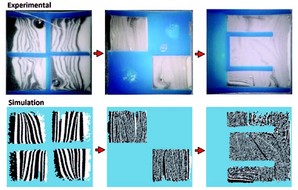
The chemical reactions used to generate solvents and certain pharmaceuticals rely on organic synthesis, a process of combining individual chemicals that can be accelerated through microwave heating. A microreactor system facilitates the direct, localized, and efficient temperature change necessary for successful synthesis. However, a uniform temperature distribution is crucial to the chemical process, and these reactions can be inhibited by unwanted temperature changes or heating that occurs too slowly. Wen-Hsuan Lee, a researcher at the Massachusetts Institute of Technology (MIT), fabricated a borosilicate glass microreactor to conduct this microwave organic synthesis, but when she tested her design in a microwave system, she discovered that the heating was uneven and below the desired temperature. Using COMSOL Multiphysics, she modeled the microreactor to investigate the effects of its geometry and orientation on the heating process. From her simulation results, she was able to redesign the microreactor and optimize its location and orientation in the microwave system to achieve successful organic synthesis.
Suggested Stories
3D Parametric Full Eye Model Gives 20+ Years of Better Vision
To correct presbyopia, researchers at Kejako, a medical device company in Switzerland, are developing a noninvasive ...
マルチフィジックスシミュレーションがスマートシティテクノロジーを推進
従来のパワーボックスはかさばり大きすぎます. スペースを意識しモジュール化され, スマートシティでの実装の準備が整ったパワーボックスを設計するとともに, 構造と熱の完全性を確保するために, Raychem RPG ...
Modeling of Laminar Flow Static Mixers
Veryst Engineering, a company that provides consulting in engineering design and product manufacturing, has ...

バイオメディカル業界におけるシミュレーションの活用の拡大
インプラントやステントから MRI や脊髄刺激まで, 数値モデリングは生物医学装置の開発にとって最も重要です. 詳細を確認し, この業界の主要なプレーヤーから話を聞いてください.


