
Konica Minolta Uses Simulation to Study and Optimize OLED Devices
Leiming Wang, Konica Minolta Laboratory, USA
As the demand for lightweight and flexible electronics continues to increase, so does the demand for lightweight and flexible light sources. Organic LEDs (OLEDs) have garnered tremendous interest because of their inherent elasticity, but suffer from a lack of brightness and efficiency. Researchers at Konica Minolta are working to alleviate these limitations and minimize light lost in their OLED designs. Using the COMSOL Multiphysics® software, they simulated the electromagnetic field and light emission distribution for a variety of nanostructured cathode geometries, determined the optimal configuration, and were able to cut light losses in half.
Suggested Stories
音の姿: エンクロージャーの設計がスピーカーの性能に与える影響を明らかにする
L-Acoustics は, アリーナやコンサートホールの音響システムに使用するバスレフ型スピーカーの最適化に, 音響シミュレーションを活用しています. 設計の進化を加速させるために, ...
マルチフィジックスシミュレーションによる計器用変圧器とセンサーの最適化
電源グリッドはシステム障害から保護するために適切に保守する必要があります. ABBのエンジニアはマルチフィジックスシミュレーションを使用して過電圧に耐え水中地下貯蔵庫応用で使用できる機器変圧器とセンサーを設計します.
Reliable Structures and Wearable Systems Call for Multiphysics Simulation
At STMicroelectronics, engineers use numerical simulation to optimize semiconductor solutions for a wide range of use ...
Submarines: Corrosion Protection or Enemy Detection?
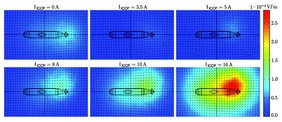
Submarines create underwater electric potential (UEP) signatures when using corrosion protection systems. These ...


