
M. Bachmann, V. Avilov, A. Gumenyuk, and M. Rethmeier
BAM Federal Institute For Materials Research and Testing
Germany
High-power laser beam welding uses a localized heat source to achieve narrow deep welds and high welding rates. Engineers run into some difficulties because the use of a localized heat source often results in the distortion of metal components; spattering and the ejection of droplets from the weld pool results in underfills, undercuts, craters, blowholes, or blowouts.
A stationary magnetic field is applied to the laser welding process to improve its quality and counteract effects such as spattering. BAM Federal Institute For Materials Research and Testing in Germany are working to improve the quality of high-power laser beam welding using COMSOL Multiphysics. To model and simulate the laser beam welding, heat transfer, fluid dynamics, and electromagnetics were coupled and solved. This allowed BAM to accurately model the process by including Marangoni effects, gravity, latent heats of fusion, and Lorentz forces.
Suggested Stories
Get a Quick Look at How Sonos Develops Innovative Smart Speakers
Innovative designs are typically not developed in one go. In this video, we meet Doug Button, distinguished audio ...
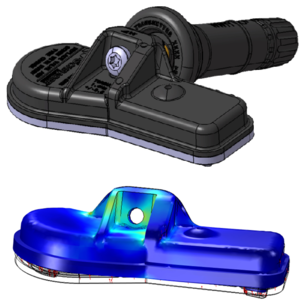
Optimizing Built-in Tire Pressure Monitoring Sensors
Built-in tire pressure sensors need to be able to withstand the wear and tear of working within a car’s tire rim. ...
A New Route to High Sensitivity Pressure Sensors
The environments in which sensors are most integral are often the most harsh and unforgiving, such as vacuum chambers, ...
Medtronic Advances Ablation Technology with Multiphysics Simulation
Researchers at Medtronic studied ablation technology using multiphysics simulation to enhance physicians' abilities to ...


