
Ivana Milanovic, University of Hartford, USA
While covering the required fundamental material in undergraduate academic programs is the top priority, students require an extra set of knowledge and skills to flourish in the workforce. This is especially true in science, technology, engineering, and mathematics (STEM) fields, where there is rarely an abundance of time for inquiry-based learning and the development of field-specific skills. To address this issue, the University of Hartford integrated multiphysics modeling into their curricula. Using the Application Builder in the COMSOL Multiphysics® software, the university created simulation-based laboratory assignments through apps, which enhanced students’ physical intuition and their ability to visualize physical concepts.
Suggested Stories
Bosch 社は自動車産業の電動化の未来に力を注ぎます
Bosch 社は, 電気自動車のドライブトレインに不可欠な2つのコンポーネントである三相インバーターと DC リンクキャパシタを設計するために, 熱および電磁界シミュレーションを実施しました. 最適化されたインバーターは, ...
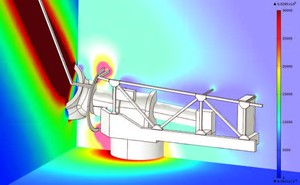
Lightning-Proof Wind Turbines
Søren Find Madsen, Global Lightning Protection Services A/S, Lejre, Denmark Global Lightning Protection Services A ...
海底ケーブルの数値モデル化による洋上風力発電所への電力供給
Hellenic Cables 社は, 有限要素モデリングを使用して, 洋上風力発電所で使用される地中海底ケーブルの設計を解析, 検証し, 持続可能な電力で世界をより良くつなぐことに貢献しています.
On the Cutting Edge of Hearing Aid Research
Nearly 20% of the United States population has some degree of hearing impairment. Despite the relative ...


