
Sergei Yushanov, Jeffrey S. Crompton, Luke T. Gritter, and Kyle C. Koppenhoefer
AltaSim Technologies
Columbus, OH
USA
Surface Plasmon Resonance (SPR) is created by surface plasmons, coherent electron oscillations existing between any two materials where the real part of the dielectric function changes sign across the interface. SPR technology is based on the electromagnetic field component of incident light penetrating into a surface and it can be used to detect molecular adsorption on surfaces.
Plasmon excitation typically exists in two configurations: the Kretschmann-Raether configuration, where a thin metal film is sandwiched between a dielectric and air, and the incident wave is from the dielectric side; and the Otto configuration, where an air gap exists between the dielectric and the metal. Using COMSOL Multiphysics, the effect of the SPR on the electromagnetic field can be defined, which has allowed for the measurement of surface contaminants and nano-scale photonic devices.
Suggested Stories
Behind the Rumble and Roar of Mahindra Motorcycles
Optimization is a subtle and delicate art, especially when it comes to motorcycles. Regulatory requirements on pass-by ...
Helicon Antenna Supports Nuclear Fusion
Built by engineers at General Atomics, the DIII-D tokamak needs to achieve temperatures that are 10 times hotter than ...
ジェネレーティブデザインで水素燃料電池の開発を加速化
Toyota Research Institute of North America (TRINA) は水素駆動自動車を開発しています. TRINA ...
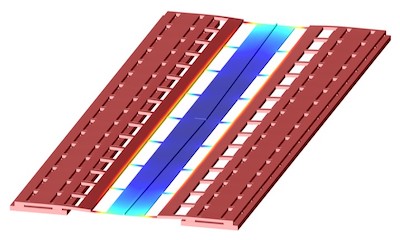
シミュレーションによるシリコンフォトニック MEMS 移相器の設計
スイス連邦工科大学ローザンヌ校の研究者は, シミュレーションを使用して, シリコンフォトニック MEMS 移相器の光学的および電気機械的性能を最適化し, それによって光ファイバーネットワークの速度, 容量, ...


