
アプリケーションギャラリには電気, 構造, 音響, 流体, 熱および化学分野に関連する COMSOL Multiphysics® チュートリアルおよびデモアプリファイルが用意されています. これらの例はチュートリアルモデルまたはデモアプリファイルとそれに付随する手順をダウンロードすることにより独自のシミュレーション作業の開始点として使用できます.
クイック検索機能を使用して専門分野に関連するチュートリアルやアプリを検索します. MPHファイルをダウンロードするには, ログインするか, 有効な COMSOL ライセンスに関連付けられている COMSOL Access アカウントを作成します. ここで取り上げた例の多くは COMSOL Multiphysics® ソフトウェアに組み込まれ ファイルメニューから利用できるアプリケーションライブラリからもアクセスできることに注意してください.
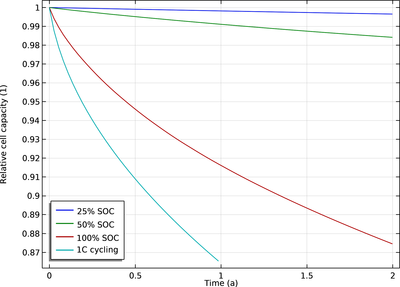
このチュートリアルでは, 電池の容量低下をモデル化するための集中電池インターフェースを紹介します. 電池内部の構造や電極の設計, あるいは材料の選択に関する知識を必要とせず, 電池内の寄生反応によって発生する容量低下を, 集中パラメーターを用いて記述します. 経年劣化解析には, カレンダー寿命とサイクル寿命の検討が含まれます. 詳細を見る
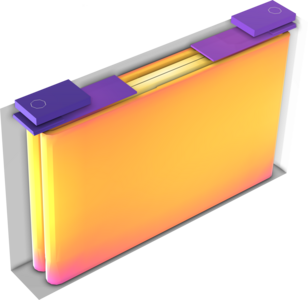
角柱型リチウム電池は, 電気自動車や蓄電システムに広く使用されています. この例では, 2つのゼリーロールを備えた完全な 3D 角柱型電池に リチウムイオン電池 インターフェースを使用する方法を示します. このモデルは, いわゆるニューマンモデルを完全に定義するだけでなく, 不可逆な活性化損失と抵抗損失 (ジュール熱) による熱源, そして可逆的なエントロピー変化による可逆損失を考慮した局所的な熱バランスも備えています. 擬似 2D モデルと比較して, 3D モデルは以下の問題を解くことができます: ... 詳細を見る
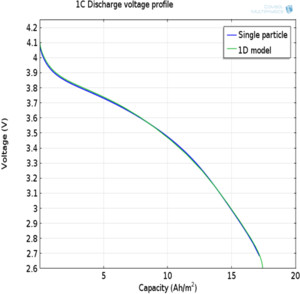
An isothermal single particle model formulation for a lithium-ion battery is presented in this work. The single particle model is a simplification of the 1D formulation for a lithium-ion battery along with a few assumptions. The model is typically valid for low-medium current scenarios. ... 詳細を見る
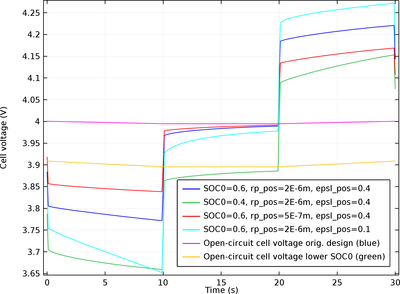
This tutorial digs deeper into the investigation of rate capability in a battery and shows how the Lithium-Ion Battery interface is an excellent modeling tool for doing this. The rate capability is studied in terms of polarization (voltage loss) or the internal resistance causing this ... 詳細を見る
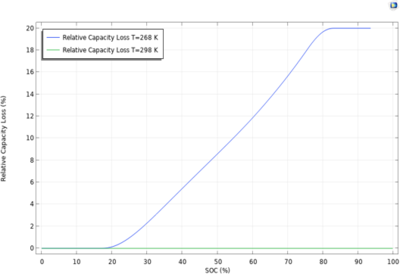
Deposition of metallic lithium on the negative electrode in preference to lithium intercalation is known to be a capacity loss and safety concern for lithium-ion batteries. Harsh charge conditions such as high currents (fast charging) and/or low temperatures can lead to lithium plating. ... 詳細を見る
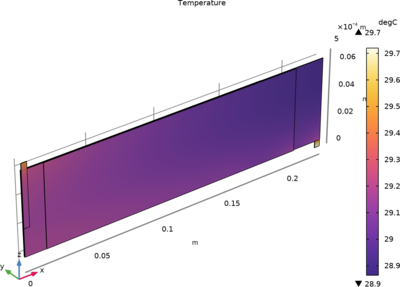
This example replicates the results of the Jelly Roll tutorial example using a flattened representation of the wound spiral-based geometry. See that model entry for details on the background, original geometry, materials, and the general physics setup. Mapping the original problem to a ... 詳細を見る
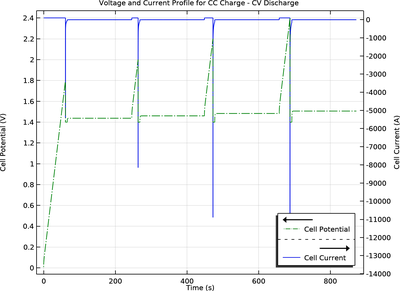
Electrochemical supercapacitors feature relatively higher energy densities than conventional capacitors. With several advantages, such as fast charging, long charge–discharge cycles, and broad operating temperature ranges, electrochemical supercapacitors have found wide applications in ... 詳細を見る

This tutorial demonstrates how to integrate multiple Lumped Battery models into the Electrical Circuit interface. Two batteries are connected in series. Each battery is protected by a shunt resistances that is activated if the battery state-of-charge reaches below a certain threshold ... 詳細を見る


