
アプリケーションギャラリには電気, 構造, 音響, 流体, 熱および化学分野に関連する COMSOL Multiphysics® チュートリアルおよびデモアプリファイルが用意されています. これらの例はチュートリアルモデルまたはデモアプリファイルとそれに付随する手順をダウンロードすることにより独自のシミュレーション作業の開始点として使用できます.
クイック検索機能を使用して専門分野に関連するチュートリアルやアプリを検索します. MPHファイルをダウンロードするには, ログインするか, 有効な COMSOL ライセンスに関連付けられている COMSOL Access アカウントを作成します. ここで取り上げた例の多くは COMSOL Multiphysics® ソフトウェアに組み込まれ ファイルメニューから利用できるアプリケーションライブラリからもアクセスできることに注意してください.

In a diode or a transistor, when a p-n junction is reverse-biased (the p-side is connected to a lower potential than the n-side), ideally, no current should flow. However, due to minority carriers (electrons in the p-side and holes in the n-side), a small current, known as the reverse ... 詳細を見る

The classical forward problem of geoelectrics (includes electrical resistivity tomography, ERT and earlier techniques as vertical electric sounding, VES) is the calculation of potentials at a given set of electrodes (M,N) while current is injected at other electrodes (A,B) into the ... 詳細を見る
This introduction model creates a simple model of the electrostatics problem with two concentric cylinders of infinite length, which is commonly found in textbooks. Since there is an analytical solution to this problem, the model can be used to compare theory with numerical results from ... 詳細を見る

The thin low permittivity gap boundary condition is meant to approximate a thin layer of material with low relative permittivity compared to its surroundings. This boundary condition is available for electrostatic field modeling. This example compares the thin low permittivity gap ... 詳細を見る
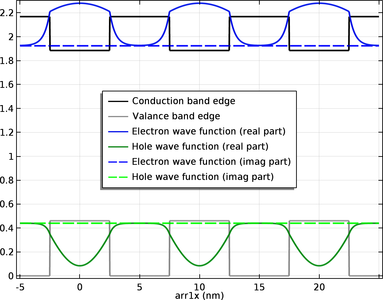
The Superlattice Band Gap Tool model helps the design of periodic structures made of two alternating semiconductor materials (superlattices). The model uses the effective mass Schrödinger equation to estimate the electron and hole ground state energy levels in a given superlattice ... 詳細を見る

Differential inductance is relevant when a low-frequency electromagnetic system includes magnets, nonlinear magnetic materials, and moving parts. These models present examples of computing the differential inductance and using these within simplified lumped models. To learn more about ... 詳細を見る
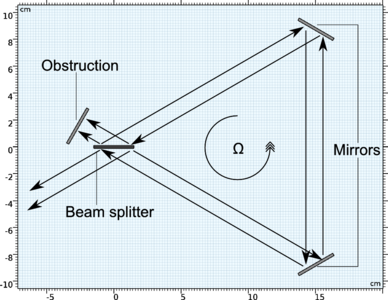
This is a model of a simple Sagnac interferometer consisting of two mirrors and a beam splitter arranged in a triangle. The entire modeling domain rotates; as a result, the rays propagating in opposite directions in the triangle have different optical path lengths due to the Sagnac ... 詳細を見る

This tutorial model shows how to set up a model of a pulsed capacitive discharge. The on pulse consists of 10 periods of excitation at 13.56MHz, followed by no excitation for 100 periods. The I-V characteristics, the electron density, temperature and plasma potential are studied. 詳細を見る


