
Buckling of a Composite Cylinder
Application ID: 67261
Buckling is a structural instability that can cause a component to fail even when the material remains within the elastic regime. Therefore, determining the critical buckling loads and corresponding mode shapes can be important from a design perspective, even when the applied loads produce only elastic deformations. For components made from laminated composite materials, the elastic properties, ply thicknesses, and stacking sequence can significantly affect the buckling loads and mode shapes.
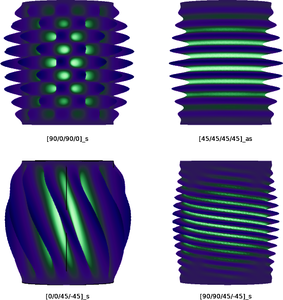
This example presents a linear buckling analysis of a composite cylinder subjected to compressive loading with fixed-end conditions. The cylinder consists of eight layers (plies) of carbon-fiber-reinforced polymer (CFRP), with different fiber orientations. The analysis uses an Equivalent Single Layer (ESL) theory-based approach. It also investigates the effect of the stacking sequence on the critical load factor for different balanced laminates, including symmetric and antisymmetric angle-ply laminates.
この model の例は, 通常次の製品を使用して構築されるこのタイプのアプリケーションを示しています.
ただし, これを完全に定義およびモデル化するには, 追加の製品が必要になる場合があります. さらに, この例は, 次の製品の組み合わせのコンポーネントを使用して定義およびモデル化することもできます.
- COMSOL Multiphysics® and
- 複合材料モジュール and
- 構造力学モジュール
アプリケーションのモデリングに必要な COMSOL® 製品の組み合わせは, 境界条件, 材料特性, フィジックスインターフェース, パーツライブラリなど, いくつかの要因によって異なります. 特定の機能が複数の製品に共通している場合もあります. お客様のモデリングニーズに適した製品の組み合わせを決定するために, 製品仕様一覧 を確認し, 無償のトライアルライセンスをご利用ください. COMSOL セールスおよびサポートチームでは, この件に関するご質問にお答えしています.


