
Micromechanics and Macromechanics of a Composite Cylinder
Application ID: 67001
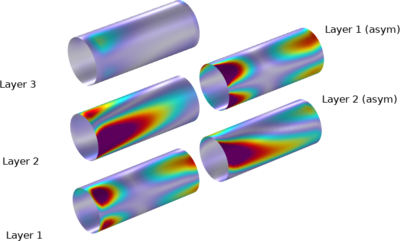
Fiber composites are widely used in industrial applications. Compared with traditional metallic engineering materials, fiber composites often offer higher specific stiffness and strength, as well as greater corrosion resistance. In addition, properties such as strength, stiffness, and toughness can often be tailored to specific applications. A fiber composite consists of load-carrying fibers embedded in a polymer resin. The composite material typically consists of a laminate of individual layers, with unidirectional fibers in each layer. This model demonstrates how to perform a stress analysis of a laminated composite cylinder.
Modeling the individual fibers in every layer of the laminate is computationally impractical. Instead, the model uses a simplified micromechanical model of a single carbon fiber embedded in epoxy to estimate the homogenized elastic properties of a single layer. It then uses these properties in the macromechanical model of the laminated composite cylinder. The laminate is modeled using two approaches: Layerwise (LW) theory and Equivalent Single Layer (ESL) theory.
この model の例は, 通常次の製品を使用して構築されるこのタイプのアプリケーションを示しています.
ただし, これを完全に定義およびモデル化するには, 追加の製品が必要になる場合があります. さらに, この例は, 次の製品の組み合わせのコンポーネントを使用して定義およびモデル化することもできます.
- COMSOL Multiphysics® and
- 複合材料モジュール and
- 構造力学モジュール
アプリケーションのモデリングに必要な COMSOL® 製品の組み合わせは, 境界条件, 材料特性, フィジックスインターフェース, パーツライブラリなど, いくつかの要因によって異なります. 特定の機能が複数の製品に共通している場合もあります. お客様のモデリングニーズに適した製品の組み合わせを決定するために, 製品仕様一覧 を確認し, 無償のトライアルライセンスをご利用ください. COMSOL セールスおよびサポートチームでは, この件に関するご質問にお答えしています.


